Where death is alive
- Alberto Rizzotti
- Feb 3, 2024
- 5 min read
Man oh man, Where do I even begin to describe this place, this day. Let's start with yesterday. We left Makassar at around 9 am. We knew that the drive to Tana Toraja would take about 8 hours, but we were not prepared for the road. A long, winding single lane, often in the mountains, with potholes as deep as small craters. It was exhausting, and you must stay very aware at all times, because there are no rules of the road in this remote place, we doubt people even have driver's licenses. A single lane often become a three lane, people stop or park their vehicles right on the road, right after a curve. If you are stuck behind a truck, you better have great driving skills to pass or your trip becomes a 15 hour affair. Needless to say, when we arrived we were ready for bed. But the scenery!!! For a while we coasted the Flores Sea, then we turned inland and were treated to the most lush, tropical area we have yet experienced. But you did not want to stop and take pictures, because trucks you passed may get back in front of you, and you certainly did not want that to happen.
But let's get back to this place and its uniqueness in the world, and perhaps you might understand why we were willing to go through the effort.
The entire area is absolutely stunning, visited by very few westerners. It seems that every gaze falls onto an area that leaves you amazed.

Pit stop on the way to Toraja


Ginger drying at our place


Local street view from car

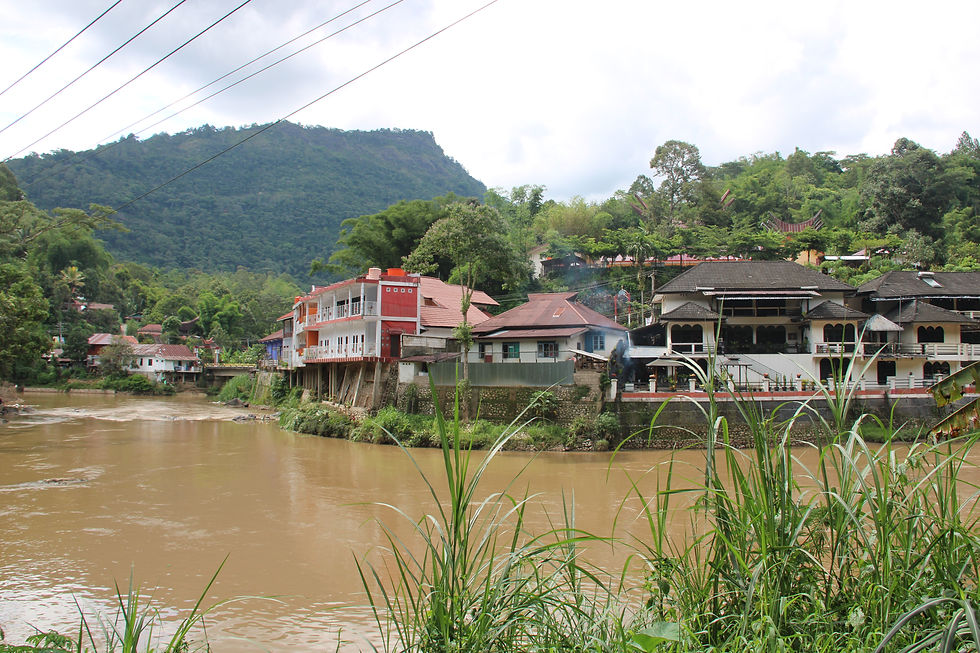
About 1 km, from our place

Trying a new look
The Toraja region has very particular looking houses, with concave roofs and absolutely amazing etched artistry. They also have smaller versions, but those are used for storage of rice. They are everywhere. From the following pictures you may get an idea.

Dinner last night at our place, The Rura Raya. We are the only guests.

View from our balcony, with the car we rented from a stranger.


This in itself is enough to make the area unique in the world, but it doesn't even come close to the main reason. This region, unlike the rest of Indonesia, is mostly Christian, however some of their beliefs have remained unchanged from their Aboriginal ways, particularly their attitude on death.
Funeral ceremonies in Toraja are very elaborate and expensive affairs, where the entire community participates and lends a hand. Because of this, it may takes years before the funeral takes place, and until that day, the deceased will continue to reside in the family home, where he is not believed to be dead yet, in fact, he or she is referred to as the sick person. They are brought food and cared for as a living member of the family, cleaned and changed.

The entire village participates in funeral preparations. These ladies are skinning and cutting bananas to make a local cake for the guests.

This temporary stage is built by the neighbors for the speeches and blessings

So are all these temporary buildings, The green is used for the slaughter of buffalos.
During the funeral, buffaloes will be slaughtered; the very rich will purchase as many as 17 buffaloes. It is believed that the buffalo will lead their spirit to a new life in the beyond. Only when the ceremony is complete is the person considered deceased. The buffalo will be consumed by the relatives first, then shared with friends and neighbors. The buffalo horns are then placed in front of the home where they will stay forever, so that their spirit can remain present.

This pink buffalo is the most prized type, which only the very rich can afford

One or more horns displayed in front of a house represents buffalos killed by the family for guiding into the afterlife

Atypical buffalo coloring.
This is just part 1. Part two is the burial. The casket is not interred, but placed in holes dug out of the mountain rock, or in natural caves, and left there. The richest will place their loved ones in very high locations on the rock, where people will have to climb with the casket to the top, then lower it where others can take over and bring it to their resting place. The middle class will bury theirs in the middle of the rock, more accessible, therefore cheaper, and the poor will make do with the bottom of the mountain. Because of the high cost, upwards of $10,000, it may be as many of ten years before the person is buried. Often, a wooden statue will be carved in the image of the deceased and placed near the burial site, called a Tau Tau.
We visited two burial sites today, with a local guide, fluent in English.

Tau tau

This burial site is called Lemo


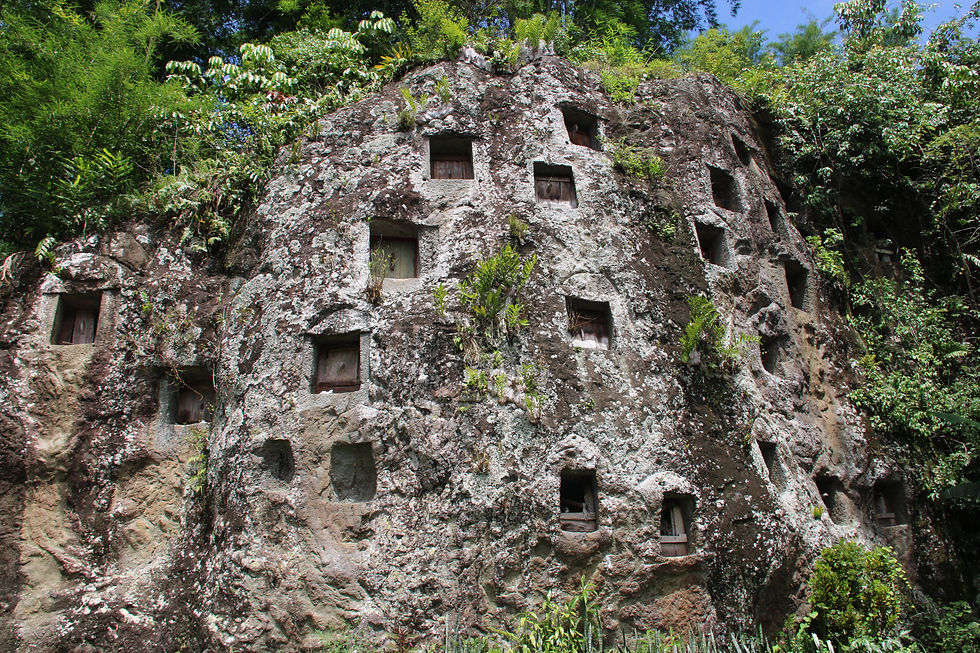
The caves we visited were those of the poorer, close to the base, easily accessible. There were skulls from previous burials were the casket had rotted or had fallen and broken, as well as recent caskets placed in this habitat.
I will be posting a couple of videos from this experience, but I wanted to get this post done first, so you could read about and know what you will be seeing.

Inside the lower burial chambers of Londa's caves. The cigarettes are left as donations to the spirit

These skulls, and other bones are from broken or rotten caskets


This entire mountain is a burial site. You'll see black spots. They are the caves where the bodies are buried, so to speak. The higher up, the richer the deceased.

The middle caves. For the middle class

The bottom caves, for the poorer. The newer caskets have been placed more recently. Some of the ancient hanging caskets on top are quite old


An incredible Tau Tau lineup of members of the same family. The clothing and facial images are those of the deceased, including eyeglasses


The entrance to the lower burial caves, with our guide


Currently it is monsoon season on the island of Sulawesi. The rains, heavy ones, happen everyday, so this is usually not the season to hold a funeral. I learned this from our guide when I inquired about seeing a ceremony. I then asked him, if by chance, we could visit a home where they are holding a dead relative, and he said that it might just be possible, as the family of one of his neighbors were actually making preparations for an upcoming ceremony. We could not believe it.
So, we took him in our car and he led the way there. We stopped to purchase two kilos of sugar and five packs of coffee for about $8 to bring to the family as an offering. They were absolutely marvelous to us. They prepared tea for Diane and I. Because of the impending funeral, the body had already been removed from their bed and placed in a coffin. I invite you to watch the videos. I will wait a bit before I upload them, but if you are sensitive, you are warned.
What more can I say? This was the most unrepeatable event we have ever witnessed. People say we don't take vacations, we do adventures. Well, they are right on.
We will leave you with a couple of pictures taken at a local market.

They invite you to take a picture, then always cover their mouth

Coffee roasting, grounding and preparation


Until tomorrow, stay healthy friends!!


Comments